Mandatory Declassification Review UAP: The USCENTCOM Gatekeepers and the FOIA Roadmap
While public attention naturally gravitates toward the tactical narratives of unidentified aerial phenomena, the most revealing data in the recent United States Central Command (USCENTCOM) releases lies hidden in the administrative margins. By tracking mandatory declassification review UAP numbers and the specific generals signing these files, researchers can map the exact boundaries of what the military has processed for release—and mathematically prove the existence of documents that remain withheld.
This metadata, often overlooked in favor of the incident descriptions themselves, provides a structural blueprint of the military's internal review apparatus. It transforms isolated document drops into a traceable, predictable system.
The Overlooked Metadata: Declassification Authorities
Every declassified Mission Report (MISREP) and Range Fouler Debrief Form processed through the USCENTCOM pipeline carries a bureaucratic fingerprint. These markers dictate who reviewed the file, when it was approved, and its specific place within a larger batch of reviewed materials.
In the archive of recent USCENTCOM UAP releases, the uap declassification authority is explicitly named in the header or footer of the documents. This is not a faceless automated system; it is a manual review process signed off by the highest levels of the command's staff. By examining these signatures, a clear timeline of the declassification effort emerges, highlighting a distinct changing of the guard between the summer of 2025 and the spring of 2026.
The Gatekeepers: MG Tegtmeier and MG Harrison
The archival record shows a traceable handover in the declassification authority. Earlier documents in the release cycle were processed under the authority of Major General Brandon R. Tegtmeier. For example, a highly detailed 10-page MISREP from November 2023, which describes an object "SHAPED AS A BOUNCY BALL" traveling at "~424kn CONSISTANTLY FOR AT LEAST 7mins", bears the stamp: "Recommendation by MG Brandon R. Tegtmeier / USCENTCOM Chief of Staff / Recommended on: 2 June 2025" (30708df4aa8484c6).
Following this period, the administrative record shifts entirely to his successor. Major General Richard A. Harrison, acting as the USCENTCOM Chief of Staff, becomes the primary signatory for virtually all subsequent releases spanning from October 2025 to March 2026.
MG Harrison's signature appears on a wide variety of incident reports. He authorized the release of a March 2023 report detailing an F-16CM flight that observed "SEVERAL BRIGHT OBJECTS MANUEVERING QUICKLY WEST TO EAST" with the stamp "Declassified by MG Richard A. Harrison / USCENTCOM Chief of Staff / Declassified on: 8 October 2025" (71ca8826db94d615). He also signed off on a May 2020 Range Fouler Debrief Form describing a "solid white object" that made "erratic moments above the water", stamped on January 26, 2026 (90b353682ba21811).
This transition from Tegtmeier to Harrison is vital for researchers. It establishes a chronological framework for when specific batches of documents were reviewed, allowing analysts to track potential shifts in redaction criteria and processing speed over time.
The Arithmetic of the Packages: Decoding MDR Numbers
The most powerful tool for researchers hidden within these margins is the Mandatory Declassification Review (MDR) number. These alphanumeric strings are not randomly assigned; they are sequential tracking codes that group documents into specific administrative packages. By applying basic arithmetic to these MDR ranges, we can prove the existence of sibling documents that have not yet been published.
Consider the footer of an August 2020 MISREP detailing a 20-hour ISR mission over the Arabian Gulf. The document notes the observation of "1X UAP" and carries the footer: "USCENTCOM MDR 26-0038 to MDR 26-0046" (39126406547c89db). This range indicates a package of nine distinct documents (0038 through 0046). If the archive only holds one or two documents bearing this specific range, the remaining numbers represent confirmed, processed files that are currently missing from the public domain.
Similarly, we see single-document MDR numbers that hint at larger sequential gaps. The November 2023 "bouncy ball" incident is labeled "USCENTCOM MDR 25-0072" (30708df4aa8484c6). The May 2020 Range Fouler form is labeled "USCENTCOM MDR 26-0019" (90b353682ba21811). The existence of 25-0072 mathematically guarantees the existence of 25-0071 and 25-0073. While we cannot know if those adjacent files are UAP-related or pertain to conventional military operations, the numbering system provides a hard ledger of the command's declassification queue.
The Package Proof: Matching Control Numbers Across Media
The archive also provides definitive proof that these MDR ranges group different types of media—such as text reports and sensor images—into single, cohesive declassification packages.
This is demonstrated by cross-referencing a specific Joint Staff control number: JS-250710-TM8S.
This control number appears on a May 2022 MISREP detailing an ISR flight from Sigonella Airbase that observed "ONE POSSIBLE SMALL UAP", which is stamped "MDR 25-0094 thru MDR 25-0099 / JS-250710-TM8S" (1822564fbae08f15).
The exact same control string and MDR range ("MDR 25-0094 thru MDR 25-0099 / JS-250710-TM8S") appears on the March 2023 F-16CM MISREP (71ca8826db94d615).
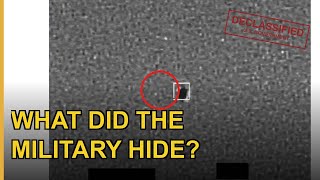
Crucially, this identical string is also found on a standalone Department of Defense sensor image. The image, which shows a luminous object with targeting reticles, bears the text "USCENTCOM MDR 25-0094 thru MDR 25-0099 / JS-250710-TM8S" alongside MG Harrison's recommendation from October 8, 2025 (1ff8c16256579734).
This proves that the declassification authority processes disparate files—multiple text reports from different years and locations, alongside visual media—as unified packages. If a researcher finds a text report with a specific MDR range, it is highly probable that associated visual evidence or entirely separate incident reports share that exact same package number.
The Practical Result: A Precise FOIA Roadmap
For investigators and journalists, this metadata transforms the Freedom of Information Act (FOIA) process. Instead of submitting broad, easily rejected requests for "UFO files" or "UAP videos," researchers can use this data to build a precise FOIA roadmap ufo strategy.
Because the MDR numbers are sequential and the package ranges are explicitly stated on the released documents, we know exactly how many documents are missing from a given batch. A requester can file a highly targeted FOIA petition asking specifically for the unreleased files within a known range—for example, requesting the release of "MDR 26-0039 through MDR 26-0045."
This methodology removes the guesswork from the FOIA process. It allows researchers to ask for documents that the military has already acknowledged, numbered, and processed through the desks of MG Tegtmeier and MG Harrison. As new documents are released, this numerical ledger can be continuously updated, feeding directly into tracking systems for future declassification releases and ensuring that no processed file slips through the bureaucratic cracks.
What the document does not say
While these documents provide a rigorous administrative roadmap, it is important to note their limitations regarding the actual phenomena and the internal logic of the military:
- The documents do not explain the criteria used by MG Harrison or MG Tegtmeier to determine which specific fields within an MDR package required redaction.
- The archive does not state whether the missing MDR numbers within a sequential range (e.g., the gaps between 25-0072 and 25-0094) contain UAP-related material or if they represent entirely unrelated classified military operations.
- The files do not explain why documents from vastly different dates and geographic locations (such as a 2022 Mediterranean flight and a 2023 Middle Eastern flight) were grouped together under the single JS-250710-TM8S control number.
- The documents do not identify the nature, origin, or physical makeup of any of the UAPs described in the reports.
Read it yourself
Explore the source documents and their declassification metadata directly in the UAP Archives: