SWIR Camera UAP: The Multispectral Disagreement Between Radar and Infrared
A cross-decade analysis of declassified military aviation reports reveals a persistent technical anomaly: unidentified objects that register clearly on advanced optical and infrared sensors while remaining entirely invisible to radar. This systematic sensor disagreement, documented in the archive from 1945 to 2024, challenges the common assumption that anomalous contacts are merely isolated equipment glitches or optical glare. By examining the corpus transversally, a distinct physical profile emerges—a selective spectral visibility that spans generations of military technology.
The Pattern That Rules Out Hallucination and Isolated Defect
When analyzing UAP sensor data, a common skeptical argument posits that visual sightings are pilot hallucinations, while instrument detections are isolated software or hardware defects. The "sensor glare" hypothesis is frequently applied to infrared targeting pod videos, suggesting that bright, anomalous shapes are simply internal lens reflections or thermal artifacts.
However, the declassified record demonstrates a pattern that directly contradicts the single-point failure theory. The archive shows a systematic disagreement between different types of sensors operating simultaneously on the same platform. The phenomenon is not defined by a universal failure of military equipment, but rather by a consistent multispectral UAP profile: confirmation by one specific segment of the electromagnetic spectrum, and simultaneous denial by another.
1944-1945: The Original Radar Disagreement
The historical baseline for this sensor discrepancy is found in the European theater of World War II. In early 1945, the Supreme Headquarters Allied Expeditionary Force (SHAEF) compiled reports from the 415th Night Fighter Squadron regarding "Night Phenomena" or "Foo Fighters." Aircrews repeatedly reported glowing red and orange cylinders and spheres flying in formation with their aircraft.
While it is tempting to dismiss these historical accounts as combat fatigue, the intelligence officers noted a specific technical detail regarding the ground-based radar network. The squadron's intelligence officer documented that despite the bright visual proximity of the objects, "In every case where pilot called GCI Control and asked if there was a Bogey A/C in the area he received a negative answer" (cc709f89f3f3de83). Ground-Controlled Interception (GCI) radar, designed to track physical aircraft, registered empty airspace exactly where crews were observing highly luminous, maneuvering objects.
2020: Electronically Silent and Instantaneously Vanishing
Seventy-five years later, modern naval aviation encountered the exact same discrepancy, updated for the digital age. A Range Fouler Debrief Form from August 2020 details an encounter by an HSM-73 pilot in the North Arabian Sea. The aircrew observed three small, unidentified air contacts. Despite having visual confirmation, the objects were electronically silent. The pilot reported "Negative ES, radar track, and IFF track" (9127fb5a81efacf0), indicating no electronic emissions, no radar return, and no Identification Friend or Foe transponder signal.
A separate debrief from October 2020, filed by a 77th Expeditionary Fighter Squadron pilot, further complicates the "glare" hypothesis. The pilot achieved a radar lock and targeting pod video on two contacts described as balloon-shaped, opaque, and metallic. The infrared (IR) sensors showed two distinct objects, with one actively maneuvering and "circling around the other" (c2bd370cdadc2f17). An optical artifact or lens glare cannot independently circle another artifact. Furthermore, the objects did not slowly fade or drift out of the sensor's field of view; the pilot noted that "IN 1/30TH OF A SECOND, THEY WERE GONE" (c2bd370cdadc2f17).
2023: Infrared Significance and the Astronomical Control
The FLIR radar disagreement continued to manifest in 2023 during Operation Inherent Resolve. A February 2023 USCENTCOM mission report details an F-15E flight over Syria that encountered three possible UAPs. The aircraft was cruising at Flight Level 270 when the crew observed the objects. The mission report explicitly states that there were "NO RADAR RETURNS RECEIVED FROM UAP" but notes that the "2 WHITE OBJECTS IR SIGNIFICANT" (46701a48cefa62a8). Once again, the objects generated enough thermal energy to be highly visible on infrared sensors, yet lacked the radar cross-section necessary to generate a return on the F-15E's APG-82 radar system.
To ensure these IR-significant objects were not simply misidentified celestial bodies—a common explanation for stationary bright spots on targeting pods—military aviators have begun conducting real-time control tests. In a March 2023 mission report involving an F-16CM, the crew observed several bright objects maneuvering quickly. To rule out astronomical phenomena, the intelligence analyst noted that the "FLT COMPARED TARGETING POD BETWEEN POSS UAP AND STAR. RESULTS WERE DIFFERENT" (71ca8826db94d615). The objects were definitively not stars, yet they remained a UFO invisible to radar.
2024: The SWIR Camera UAP Anomaly
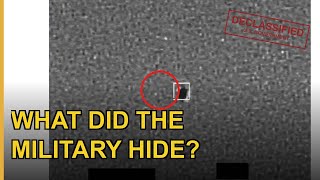
The most recent and specific example of this selective spectral visibility comes from a January 2024 USCENTCOM mission report. An intelligence, surveillance, and reconnaissance (ISR) aircraft observed a UAP traveling at approximately 434 knots. The object was described physically as a "ROUND DIAMOND SHAPE WITH STRAIGHT, NON MANUEVERABLE 'TAIL'" (bd5478d2e420f6ff).
Crucially, the report highlights a severe sensor discrepancy. The object was not visible to the naked eye, nor did it register on standard electro-optical or radar systems. The official mission narrative states unequivocally that "THE UAP ONLY APPEARED ON THE SWIR CAMERA" (bd5478d2e420f6ff). Short-Wave Infrared (SWIR) cameras detect reflected light in a specific wavelength band (typically 0.9 to 1.7 microns) that is invisible to human vision and distinct from the thermal emissions captured by Mid-Wave or Long-Wave IR. The fact that a structured, diamond-shaped object with a tail was exclusively visible in the SWIR band points to highly unusual material properties or atmospheric interactions that absorb or scatter other wavelengths while reflecting SWIR.
Why "Sensor Glare" Fails to Explain the Pattern
The universal debunk of "sensor glare" relies on the assumption that the observer is misinterpreting a localized, internal camera artifact as an external physical object. However, the transversal reading of UAP Archives demonstrates that this explanation is insufficient for the documented military encounters.
Glare does not trigger visual sightings by pilots while simultaneously failing to register on ground radar, as seen in 1945. Glare does not circle another piece of glare before vanishing in a fraction of a second, as documented in 2020. Glare does not yield different targeting pod diagnostic results when actively compared to a star, as tested in 2023. Most importantly, glare is generally a broad-spectrum optical artifact; it does not selectively restrict its appearance exclusively to a SWIR camera while remaining invisible to all other onboard multispectral sensors.
The true pattern is not one of sensor failure, but of sensor disagreement. The physical property of being highly luminous in specific infrared bands while remaining entirely transparent to radio frequencies (radar) is a consistent, documented characteristic of these objects spanning eight decades.
What the document does not say
While these documents provide detailed technical parameters regarding sensor capabilities and limitations, it is vital to acknowledge what the archive does not claim:
- The documents do not state that these objects are extraterrestrial in origin.
- The reports do not offer a physical or aerodynamic explanation for how a metallic or solid object can remain entirely invisible to military radar systems.
- The files do not explain the propulsion mechanisms that allow objects to vanish in 1/30th of a second or travel at 434 knots without apparent flight control surfaces.
- The archive does not conclude whether the SWIR-exclusive visibility is a deliberate stealth countermeasure or a natural byproduct of the object's operation.
Read it yourself
Verify the sensor data, mission narratives, and historical radar discrepancies directly in the declassified source files: