UAP Sensor Frames Reassembled: The 11-Minute Engagement Released as 6 Scrambled PDFs
The recent release of fragmented sensor imagery presents a unique archival challenge: a continuous 11-minute UAP engagement published as a disorganized collection of single-page PDFs. By reassembling these isolated frames using their embedded timestamps, a coherent narrative emerges of a tracked object that appears to divide in two, demonstrating the value of rigorous chronological reconstruction.
The Puzzle: 6 Scrambled PDFs
When government agencies declassify sensor data, the method of release can sometimes obscure the underlying event. In this instance, the archive received a series of isolated, single-page PDF documents. Rather than being presented as a continuous video file or a sequential storyboard, the frames were published entirely out of order.
Furthermore, the files bear a confusing array of institutional attributions. Various frames from what is visibly the exact same sensor system and the exact same engagement are titled differently, attributed to the Department of Defense (DoD), the Unidentified Aerial Phenomena Task Force (UAPTF), the All-domain Anomaly Resolution Office (AARO), and the Department of Homeland Security / Customs and Border Protection (DHS/CBP).
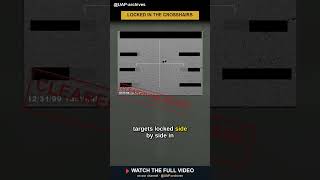
This fragmentation creates an artificial puzzle. A researcher looking at a single frame might conclude it represents an isolated incident. However, a close examination of the on-screen display data—specifically the timestamps and the targeting reticle—confirms that these disparate files are actually sequential stills extracted from a single, continuous recording. The archival work of reassembling these frames is a necessary step to understand the actual scope of the documented engagement.
Chronological Reconstruction: An 11-Minute Engagement
By extracting the timestamp data visible in the lower-left corner of the sensor displays, we can reconstruct the timeline of the event. The sequence begins at exactly 18:10:00, as shown in the initial frame where a "small, dark, unidentified object" is positioned near the center of the crosshair (DoD UAP file).
The engagement continues for over eleven minutes. We have confirmed frames at 18:10:50 (Still image from a sensor display), 18:18:58 (DoD/UAPTF sensor data), 18:20:08 (DoD/Military sensor footage), and 18:20:41 (DoD/UAPTF/AARO file). The final available frame in this sequence is stamped 18:21:02 (DHS / CBP UAP Video Still).
This chronological mapping proves that the sensor platform maintained a sustained track on the target for a minimum of 11 minutes and 2 seconds. The continuity of the background grain, the consistent typography of the heads-up display (HUD), and the steady progression of the clock leave no doubt that this is a single continuous event, despite the scattered nature of the declassified release.
The Key Moment: One Object Becomes Two
The most significant operational detail revealed by the chronological reconstruction is a change in the number of tracked objects. For the first eight minutes of the reconstructed timeline, the sensor crosshair targets a single entity. At 18:18:58, the display still shows only one "small, unidentified object near the center" (DoD/UAPTF sensor data).
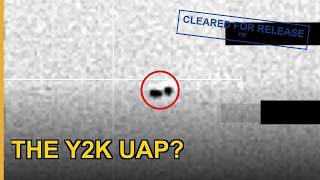
However, when the timeline resumes at 18:20:08, the situation has changed. The sensor footage frame now shows the crosshair "targeting two small, dark objects" (DoD/Military sensor footage). Interestingly, this dual-target tracking is not continuously maintained. Just seconds later, at 18:20:41, the display reverts to showing a single "unidentified object" at the center of the crosshair (DoD/UAPTF/AARO file). The sequence then concludes at 18:21:02, which again clearly features "two small, dark objects near a central crosshair" (DHS / CBP UAP Video Still).
Crucially, the exact moment of this initial transition—the point at which one object becomes two, whether through division, the arrival of a second object, or a sensor resolution artifact—falls entirely within the 70-second gap between the 18:18:58 and 18:20:08 frames. The declassified stills omit the precise moment of this critical change.
Zoom Shift and the Unredacted Anomaly
Accompanying the change in the number of objects is a distinct shift in the sensor's magnification or field of view. In the earlier frames, the horizontal axis of the crosshair reticle displays numerical scale markings of "15 10 5 5 10 15" (DoD UAP file). By the time the two objects appear at 18:20:08, the scale has changed dramatically, showing only the number "3" on the reticle (DoD/Military sensor footage), indicating a tighter zoom or a different sensor mode.
Amidst this technical data, there is a notable archival anomaly regarding redactions. Almost every frame in the sequence features heavy censorship of the surrounding HUD data, with redaction levels ranging from 21% to 28% of the total image area. Yet, the frame captured at 18:10:50 is entirely untouched. It is described as having zero redactions detected, showing the "central crosshair, numerical markings on the horizontal axis, and a timestamp" against a grainy background without any blacked-out blocks (Still image from a sensor display). The reason why this specific second of footage was cleared in full while the surrounding minutes required heavy redaction remains unexplained by the source files.
The DHS/CBP Label Anomaly
The bureaucratic labeling of these files presents another layer of complexity. As noted, the frames are visually identical in source, yet they carry different agency designations. The most glaring divergence occurs at the very end of the sequence. The frame at 18:21:02 is titled "DHS / CBP UAP Video Still" (DHS / CBP UAP Video Still).
Customs and Border Protection (CBP), a component of the Department of Homeland Security (DHS), operates its own fleet of sensor-equipped aircraft. The sudden appearance of a DHS/CBP label on footage that was previously designated as DoD, UAPTF, or AARO raises questions about the chain of custody of the video. It is unclear if the platform recording the event belonged to CBP, or if CBP simply received a copy of DoD footage that was later declassified under their specific purview.
Epistemic Caveat: The 1999-12-31 Timestamp
Every frame in this sequence bears the identical date stamp: "12/31/99" (DoD UAP file). While it is tempting to catalog this as a New Year's Eve 1999 incident, strict archival discipline requires us to treat this date with caution.
In digital and electronic systems, December 31, 1999, is a common default date for unconfigured clocks, often associated with Y2K-era hardware resets or systems that have lost battery backup for their internal timekeeping. Without corroborating metadata, flight logs, or narrative reports, we cannot state as a fact that this event occurred in 1999. The date is a hypothesis based on the on-screen display, not a verified historical fact.
The Triple Negative Space
In archival research, what is withheld is often as informative as what is released. This collection is defined by a triple negative space. First, there is the absent source video. The release of 6 isolated frames confirms that a continuous video recording exists, yet only these fragmented stills have been provided.
Second, there is the redacted telemetry. Up to 28% of the data fields in frames like the 18:20:41 image are obscured (DoD/UAPTF/AARO file). This hidden data likely contains critical flight parameters, GPS coordinates, altitude, and sensor azimuth—the exact metrics required to calculate the size, speed, and location of the objects.
Third, and most critically, there is the missing transition. The exact moment the single tracked object becomes two objects is entirely absent from the selected frames. The gap between 18:18:58 and 18:20:08 represents a deliberate or coincidental omission of the engagement's most anomalous event.
What the document does not say
- The documents do not identify the objects tracked by the sensor system.
- The files do not state the location, altitude, or speed of the engagement.
- The archive does not explain how or why the single object became two objects.
- The documents do not confirm that the event actually took place on December 31, 1999; the date may be a system default.
- The files do not explain why identical footage is attributed to multiple different agencies (DoD, UAPTF, AARO, DHS/CBP).
- The documents do not provide any explanation for why a single frame at 18:10:50 was released without the heavy redactions applied to the rest of the sequence.