UFO Files Release 3: What Was Published and What MDR Gaps Can Tell Us
Update, July 20, 2026: Release 3 was published on June 12 and is now available in our complete Release 3 index. Release 4 followed on July 10. This article began as a pre-release hypothesis; it is preserved as a retrospective and the claims below have been corrected where the available records did not support certainty.
Before Release 3, we examined Mandatory Declassification Review (MDR) numbers in USCENTCOM mission reports to look for possible groupings. One report describes an F-16CM flight that observed "SEVERAL BRIGHT OBJECTS MANUEVERING QUICKLY" (71ca8826db94d615). Its MDR range was a useful lead for comparison, but it was not proof of what a later release would contain.
What the release cadence showed
The official reading room publishes records in dated batches. Individual documents may show review authorities, routing stamps, and MDR identifiers, including approvals associated with USCENTCOM Chief of Staff MG Richard A. Harrison. Those markings help researchers group records and reconstruct provenance. They do not, by themselves, disclose the government's publication schedule or establish that a missing sequence number represents a withheld file.
What MDR sequence analysis can—and cannot—show
MDR identifiers can reveal that records passed through related administrative review ranges. Gaps are leads for further research, not evidence that a specific unpublished document exists. A number may refer to another record, a page range, an administrative action, or material that will never appear in this collection. The archive does not provide enough information to distinguish those possibilities with certainty.
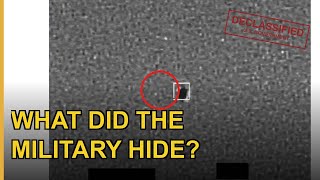
For instance, a March 2023 USCENTCOM mission report is stamped "MDR 25-0094 thru MDR 25-0099" (71ca8826db94d615). A cleared grayscale sensor image carries the same range (1ff8c16256579734). That overlap supports treating the items as administratively related, but it does not tell us how many other records exist or whether they will be published.
An August 2020 report carries "USCENTCOM MDR 26-0038 to MDR 26-0046" and notes that an aircraft "OBSERVED 1X UAP" at 0726Z (39126406547c89db). A separate Range Fouler Debrief Form is labeled "USCENTCOM MDR 26-0019" (90b353682ba21811). The numerical distance between them is worth documenting, but it cannot establish the contents or status of intervening records.
Administrative signals
Routing stamps such as "Approved for Release to AARO" document a transfer or review step. Combined with dates and authorities, they help reconstruct a record's path. We no longer describe those signals as a reliable publication-warning system: the sample is too small and the official archive does not expose enough workflow data to validate that claim.
What was indexed
Release 3 is now indexed by publication date, media type, and source. The release hub is the canonical place to see its current inventory and any extraction warnings. OCR text is an automated aid; the source PDF remains authoritative.
To understand what these top findings look like, we can look at the strongest items from the current MDR sequences. In one instance, an F-16CM targeting pod captured an object for approximately 20 seconds before it "WOULD BECOME DIM AND DISAPPEAR" (71ca8826db94d615). The analyst comment explicitly noted that the flight crew compared the object to a star, and the "RESULTS WERE DIFFERENT" (71ca8826db94d615).
In another encounter, an ISR crew tracked a "solid white object" making "erratic moments above the water" before losing the track due to poor sensor placement (90b353682ba21811). The crew noted on the debrief form that the object was "Round" and "Opaque" but lacked "Moving Parts" or "Apparent Propulsion" (90b353682ba21811). These examples show why related MDR records are useful research leads, without establishing what any absent sequence contains.
Comparative Analysis: Release 1 vs. 2 vs. 3
The published Release 3 can be compared with the earlier batches to examine how the collection evolved. Early releases heavily featured NAVCENT (Naval Forces Central Command) and standard ISR logs. For example, the August 2020 Arabian Gulf mission involved coordination with NAVCENT to scan for vessel activity before the UAP was sighted, an event the report notes had "NO IMPACT TO MISSION" (39126406547c89db).
The records examined before Release 3 showed more USAF and joint USCENTCOM material spanning 2020 into early 2023. The formats also diversified. While earlier files were predominantly text-based MISREPs (Mission Reports), the newer sequences include standardized Range Fouler Debrief Forms designed specifically for data collection on unidentified contacts (90b353682ba21811). They also include cleared visual media, like the grayscale sensor image recommended for release by MG Harrison (1ff8c16256579734). The idea that this would predict the complete Release 3 media mix was a hypothesis, not a result; use the release hub to evaluate the published inventory directly.
What the document does not say
While these files provide detailed tactical accounts of military encounters with unidentified objects, it is vital to maintain an objective reading of the archive. The documents do not state:
- That any of the observed objects are extraterrestrial in origin.
- The final identification or resolution of the "solid white object" or the "bright objects" tracked by the F-16CM.
- The specific classified capabilities of the sensors used; details regarding radar software loads, IRCM, and ECM designators are frequently redacted or left blank.
- Any connection between the UAP sightings and the routine guard calls from foreign military forces, such as the Iranian Air Defense Guard mentioned in the 2020 ISR report.
Read it yourself
- USCENTCOM declassified mission report (MDR 25-0094 series)
- USCENTCOM MDR
- USCENTCOM Range Fouler Debrief Form
- Department of Defense / USCENTCOM
Browse the complete Release 3 index, then compare it with Release 4. Editorial videos are clearly labeled separately from official footage.