Apollo 17 UFO: The Lunar Flash Report the Pentagon Is Reanalyzing
Declassified air-to-ground transcripts and a newly opened Department of War investigation under the PURSUE program reveal that the Apollo 17 crew tracked unidentified flashing objects in space and observed an unexplained light on the lunar surface. Decades after the December 1972 mission, these anomalies remain the subject of an active government inquiry involving original mission film and audio.
A Lunar Module Pilot's Observation of a Lunar Flash
A specific transmission from Apollo 17 Lunar Module Pilot Harrison Schmitt in lunar orbit is particularly notable. According to the mission's air-to-ground voice transcription, Schmitt interrupted the standard commentary to report an anomaly on the surface.
"Hey, I just saw a flash on the lunar surface!" Schmitt transmitted to Mission Control (9d041c8799a0124d). When asked for details, he specified the location as being "just out there north of Grimaldi," referring to a large, dark mare region on the western edge of the moon's near side. He described the event as a "bright little flash right out there near that crater" and noted a "thin streak of light" (9d041c8799a0124d).
The observation was taken seriously by Mission Control in Houston. The capsule communicator requested that Schmitt mark the exact location, stating, "How about putting an X on the map where you saw it." Mission Control also confirmed they would check their seismometers to see if a small impact had registered, after Schmitt noted that such an event "probably would give a fair amount of visible light" (9d041c8799a0124d).
Tracking Flashing Objects in Transit
The lunar surface flash was not the only unusual visual phenomenon recorded during the mission. While in transit, the crew observed and tracked objects outside their spacecraft. Commander Gene Cernan explicitly distinguished these objects from the immediate debris field of the spacecraft.
Cernan reported a "bright object, and it's obviously rotating because it's flashing" (9d041c8799a0124d). He emphasized the distance of the object, stating it was "way out in the distance... definitely not a particle that's nearby" and estimated its position at "maybe 10 or 12 Earth diameters" away (9d041c8799a0124d). The object exhibited a specific pattern, with Cernan noting it had "two flashes" that occurred in a "rhythmic fashion"—a "very bright flash; and then you get a dull flash" (9d041c8799a0124d).
Mission Control engaged directly with this sighting, asking the crew to provide spacecraft attitude data so they could "work out a set of GIMBAL angles" and attempt to locate the object through their own optics (9d041c8799a0124d). Later in the transcript, Cernan updated Houston that the situation had evolved: "We got two of those flashers out there... widely separated" (9d041c8799a0124d).
The 1973 Technical Debriefings
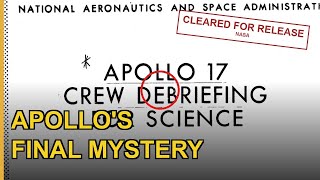
The anomalies were formally entered into the mission's historical record during the technical crew debriefings in January 1973. In a document bearing a May 2026 declassification stamp, Schmitt reiterated his observation, stating simply, "I had one which I thought was a flash on the lunar surface" (2c874c40c55505f2).
During the same debriefing, Command Module Pilot Ronald Evans described another unusual visual experience, recalling a "fireball" and looking through the rendezvous window to see "what to me was kind of like a tunnel with a bright spot in the middle" (2c874c40c55505f2).
The scientific rigor of the crew is further documented in their January 8, 1973, science debriefing, where they discussed complex astronomical observations, including Lyman-alpha radiation, the Coma cluster, and ultraviolet backgrounds (5d7db3870de8c01a). This context underscores that the crew consisted of highly trained observers accustomed to identifying known astronomical and physical phenomena.
The Audio Record of "Jagged" Particles
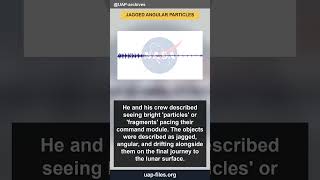
The archival corpus also includes the original audio recordings of the crew's transit observations. In these tapes, the astronauts describe a field of debris drifting near the Apollo spacecraft and the separated Saturn S-IVB stage. The crew characterizes the materials as "very bright particles or fragments" that appear "jagged" and "angular" (9d041c8799a0124d).
The audio excerpt captures the crew noting that these fragments "twinkle" as they tumble and slowly move away from the S-IVB stage (aud-1007872). The visual field was so dense at one point that Schmitt remarked, "It looks like the Fourth of July out of Ron's window" (9d041c8799a0124d).
The PURSUE Investigation and the Triangular Anomaly
While the transcripts and audio provide a compelling historical narrative, a recently declassified case file elevates the Apollo 17 sightings to a matter of contemporary government interest. Under the PURSUE program, the Department of War has opened an active investigation into a specific photograph taken during the December 1972 mission.
The image in question contains "three 'dots' in a triangular formation in the lower right quadrant of the lunar sky" (img-nasa-uap-vm006-a). According to the case summary, while the photograph has been publicly available and debated by civilian observers for years, new preliminary analysis by the United States government suggests that the feature is "potentially the result of a physical object in the scene" rather than a simple camera artifact or film defect (img-nasa-uap-vm006-a).
To resolve the anomaly, the government has obtained the original Apollo 17 mission film for full reanalysis by NASA and the Department of War (img-nasa-uap-vm006-a).
Prosaic Explanations on the Record
In keeping with archival standards, it is mandatory to record the prosaic explanations that the astronauts themselves offered in real-time. The crew did not immediately leap to extraordinary conclusions regarding the nearby particles.
When discussing the jagged fragments outside the window, Evans speculated that there were a number of possibilities, suggesting they might be "ice chunks, possibly. Or maybe there's paint coming off" the S-IVB stage (9d041c8799a0124d and aud-1007872). Mission Control concurred, noting that they had seen paint peeling on similar hardware in the past.
Additionally, Cernan reported seeing a "very bright spot that flashed right between my eyes like a very bright headlight" while trying to sleep (9d041c8799a0124d). These specific internal flashes were part of a known phenomenon of light flashes, which the crew was actively monitoring for the ALFMED experiment (2c874c40c55505f2).
An Active Investigation
The Apollo 17 anomalies represent a rare intersection in the archive: a historical case featuring a witness (Harrison Schmitt) and an official, ongoing government investigation. The PURSUE program's acquisition of the original mission film indicates that the Department of War believes the triangular anomaly warrants modern analytical techniques. Until the final results of the joint NASA and DOW analysis are released, the true nature of the objects tracked by the crew and the flash observed near Grimaldi remains an open question in the historical record.
What the document does not say
- The documents do not claim that the flashing objects or the lunar surface flash were extraterrestrial spacecraft.
- The archive does not provide a definitive identification for the "three dots" seen in the mission photograph.
- The transcripts do not conclude whether the flash north of Grimaldi was a meteor impact, a geological event, or something else.
- The files do not dismiss the crew's observations as hallucinations or optical illusions; Mission Control actively attempted to track the objects using the crew's data.
Read it yourself