
NASA Mercury Program file, likely a transcript of John Glenn's debriefing after the Friendship 7 (MA-6) mission.
Transcript of a debriefing with an early US astronaut about visual phenomena observed from orbit. Topics include dark adaptation, celestial objects, atmospheric effects, and a detailed account of mysterious luminous particles seen outside the space capsule.
Generated from extracted text. Verify important claims against the original document.
▶ UAP Archives explainer
This video is UAP Archives editorial content based on the linked official records; it is not government footage.
Subscribe to UAP Archives on YouTube →

Related documents
Files connected by shared people, places, and events — and by appearing together in our cross-document analysis.
- pdfNASA-UAP-D018, Gemini 4 Experiment Debriefing, 1967mesma análise · john · bob
- pdfNASA internal filesroach · jocelyn r. gill · dubin
- pdfNASA Gemini Program Filesjohn · st. louis · pacific
- pdfNASA-UAP-D019, Gemini 5 Technical Debriefing, Part I, 1965john · venus · australia
- pdfNASA Gemini Program Filesjohn · the cape · venus
- pdfNASA Gemini Program Filesjohn · the cape · southern california
Extracted images
Images flagged by the classifier as photographs, maps or sketches.
Pages (216)Machine-extracted text; expand to inspect pages and cite exact anchors. Verify against the PDF.View more ↓
Miss Reeves X20593
....... a little bit, my skin waswet and it didn't stick the way it had stuck when we tried it out in the trainer and in the capsule on the pad and I finally gave up on it and just kept one eye shut. This is marginally satisfactory, I guess, but I was not well nighted after comin…
2
degree of adaptation out of. I could notice a difference in the number of stars I could see, first just after the sun plant went down and later on then when I'd be well night adapted (at the end of the period.) This is some 30 or 31 minutes later when you're approaching sunrise s…
3
3 stars. But a general impression of looking out at these areas was that the numbers of stars I could see was not greatly increased. You mention the transmission through the glass be comparable ... to the atmosphere. That's something you people can check? That's right. McDona…
4
— Was this bothered or being bothered by moonlight on the windows or was the sky actually bright? No. The sky was not bright. I didn't notice the sky being bright at all nor was it moonlight bothering on the window of the capsule. It was moonlight on the surface of the earth bac…
5
5 This didn't seem to be any problem. Looking up fairly close to the moon, I would guess a--counting a number degrees probably, you could see right up to the edge of the moon. The stars would be visible right up--very close, its not like it is when- [you ohserve the moon from the…
6
6 this was very similar. You do the same thing there and I had no--there was no problem with the eyes. The light though, it was very noticable. The light was a very brilliant clear, white light and what it looked like coming in the window and the way it looked on the suit--the be…
7
7 from there on. Thats what I was prepared to see, I guess, but this wasn't the way it was at all. The sun goes down and its a brilliant display. Theres all the spectrum lined up here almost. Just as the sun goes down--well before the sun goes down you have a broad band .........…
8
8 Solar Corona. No. This--once again I think to observe these things properly we are going to have to be night adapted before we get there and thats what we lost by having other complications on the second [REDACTED]. To get back to the unanticipated celestial features. Well,…
9
probably a degree and a half to two degrees wide and it was quite visible once you start looking for it. It may/XXXX seemed to go out and taper out. No, it didn't taper as much as the light at the horizon did during sunset. It was more of a solid type ha band. It looked like the…
10
10 identified by the previous shot. I think maybe this one Mercury. Lee haz check the chart on it. See any stars Zodical light. No. Solar Corona. No. I was not well enough adapted to patterns along that line. Shadow of earth of sky? No. To photograph the Orion region, it loo…
11
11 rate of magno control inputs and you'd start a little drift from very slow. Probably the drift rates went out over a quarter of a degree per second during the time that I was trying to make the pictures. But thats enough if you drift off and you have to correct back the line…
12
12 it visually or on instrument. And since we were having automatic control trouble presentation on the attitude, I was trying to maintain control looking back out the window and to check back and forth between the very brilliant and bright light coming in at sunrise through the…
13
13 but you see a whole thunderhead light up and [REDACTED] and another one would [ILLEGIBLE] light up over here and there would be some light go back and forth from here like this way/ horizontally. And then you would see another one light up and there was a bit lot of thunderst…
14
14 that the weather would be so that you wouldn't see any of this but you could see little bumps along in the twilight glow after the sunset and this shows up in some of our pictures. You can see these little bumps along. Do you have copies of those up here? Not up here. I saw s…
15
15 You might be able to try this. I didn't try it that way. You might be able to, holding your head fix you might be able to do something like that. This would be fairly accurate. This would put it down, I think, where you could pick it off within a--our gradations on that attitu…
16
16 through the window like 2 suns or satellite......? Did.you.see.any multiple images./... (question partially inaudible........XX No, no. Could I a question here on the surface? Go ahead. I notice on the picture here and also the comet the description of the on the horizon i…
17
17 You notice any--very many clouds or any peculiar cloud formations? Yes. We got quite a number of cloud plat pictures and you can pick out the relative types of clouds. We did wonder whether you could tell vertical clouds from SAC-OS clouds. You can tell what clouds are verti…
18
18 It ran up and looked like it ran off the edge of a . Then there were some white areas way up to the North and I imagine these were probably snow fields. I thought at the time they probably were but I couldn't be sure. I didn't specifically go over any area where I could look r…
19
19 I could see no difference in flying in an airplane at 50,000 feet and looking down and seeing colors on the ground then there is from the capsule. Lets Mswitch the subject again. Did you have an opportunity to try closing your eyes and seeing the Sorenhoff Radiation flashes?…
20
20 Thats a good one. That sure is. Were they all traveling in the same direction and the same velocity? Yes. They all just appeared to be se sitting out here floating and they particular didn't have any interaction with each other. They were-- some vent running this way and som…
20
20 The density looking perpendicular to your path is about equal to that I had 2 things came in mind. One was, I thought we found the lost ZEN Air Force needles, that He was the first thing. But they weren't-- wasn't like that at all. The other thing, I thought perhaps we were g…
21
21 (Question, partially inaudible)............ in the shadow of the capsule they were simply white like snow? Thats right, thats right. They were very liminous. When the first rays of the sun would come--when the first rays of the sun came by the capsule is when I'd see the firs…
21a
[REDACTED] (Statement, partially inaudible) [REDACTED] [REDACTED] advancing a new theory that this might very well be some full luminescence of areas [REDACTED] around the capsule [REDACTED] we talked about this a night and day change [REDACTED]. Whether theres anything of this…
22
22 No. These one that would come fairly clost to the capsule I could see. Thats where I estimated they were just a very tiny size up to maybe 3/8 of an inch or half an inch. Would you characterize them as sort of irregular like cornflakes, like crystal, like snowflakes? They di…
23
23 They all went by in the direction of That's right. How, I turned around once so I could see if they vere coming toward me. I got around facing toward the singlight sunlight. As I came around and the sunlight was off to my right I could see far fewer of them at that time than…
How close Six to ten feet apart. (Question, partiallyinaudible) .......you said you saw it 3 times. Did you? This was approximately the same......... Well, this was right at each sunrise. Now this was mother thing we talked about. Bill Douglass, I think, fes felt that there m…
25
25 Did you have the impression they would be there if you they were about 6 to 7 feet apart. The window is only a certain size - (Statement, inaudible) Well, I had the impression I could have sat--I could have been sitting there and watch one particle for some distance as it w…
26
26 as I could start to begin to see some faint light down below and I glanced back up at the window and my first impression was, well we've gotten way out of attitude and probably come to the because here it was just like looking out on a complete star field, there was no other r…
27
27 You can't see them on the film? No. The ones we had out there at Grand Turk I couldn't very--we had to many scratches and spots on those pictures that I couldn't really pinpoint them. But when we get hold of the original pictures and can project those, I hope that we can see…
28 in brightness Were there any changes/looking out the side cross your and back? No. I don't recall any. We talked about that too and I couldn't recall that they looked any different in one direction than they did in another. (Question, inaudible)....? No. (Statement, inaudible)…
29 There would not only be an electric charge, there would be a differential charge between the window and the outside of the capsule which could explain (Statement, inaudible)..... (Question, inaudible)....? Well, thats a pretty is tough one. I don't know. That would be like--…
30 I'd like to get together again because this was the first real honest to goodness business like this we've conducted since I got back here and this is what I want to get back to next week. I'm going back to the Cape Monday night. I'm going to be down there all next week on tou…
ROUGH DRAFT: 3/13/62 CODE SCG: MD:dd
ROUGH DRAFT: 3/13/62 CODE SCG: MD:dd MEMORANDUM to Director, Office of Space Sciences Subject: Considerations and Recommendations of Manned Space Exploration Following the Interview (February 27) with Lt. Col. John H. Glenn, Jr. Col. Glenn presented a very detailed and factual de…
-2-
-2- The consistency in the observations on the three separate orbits would require that the particles were associated with the spacecraft itself ( I have heard that O'Keefe has investigated the life support system which would ) Col. Glenn described the particles and the luminosit…
-3-
-3- significant observations of the starfield or the moon. In the absense of atmospheric scattering the sun appeared a brillant white, but showed no signs of corona. It is of interest, however, to consider Col. Glenn's observation of a band six to eight degrees above the horizon,…
-4=
-4= recommendations appear to be aparent following the very successful flight of the Mercury capsule. The astronaut-scientist carrying out the ob- servations from a space vehicle should publish under his name(with an associate) in a widely distributed scientific journal. In this…
-5-
-5- 6. For air glow and optical studies, the photo- multiplier for systems and a series of filters if available, (including a possible fluorescent plain filter to study the ultra violet) should be incorporated into the spacecraft. Because a number of scientific experiments appear…
In reply refer to: SGA(JRG:sml)
In reply refer to: SGA(JRG:sml) MEMORANDUM for the Files Subject: Telephone conversation with Dr. John O'Keefe from Cape Canaveral The following information was gathered from a con- versation with Dr. O'Keefe on Wednesday, Feb. 21, 1962: Astronaut Glenn reported having seen SMALL…
IN REPLY REFER TO: J-16-812
IN REPLY REFER TO: J-16-812 UNIVERSITY OF CALIFORNIA LOS ALAMOS SCIENTIFIC LABORATORY (CONTRACT W-7405-ENG-36) P.O. Box 1663 LOS ALAMOS, NEW MEXICO July 13, 1962 Dr. Jocelyn Gill Room 62033 Federal Office Bldg. No. 6 Headquarters, N.A.S.A. Washington 25, D. C. Dear Dr. Gill: The…
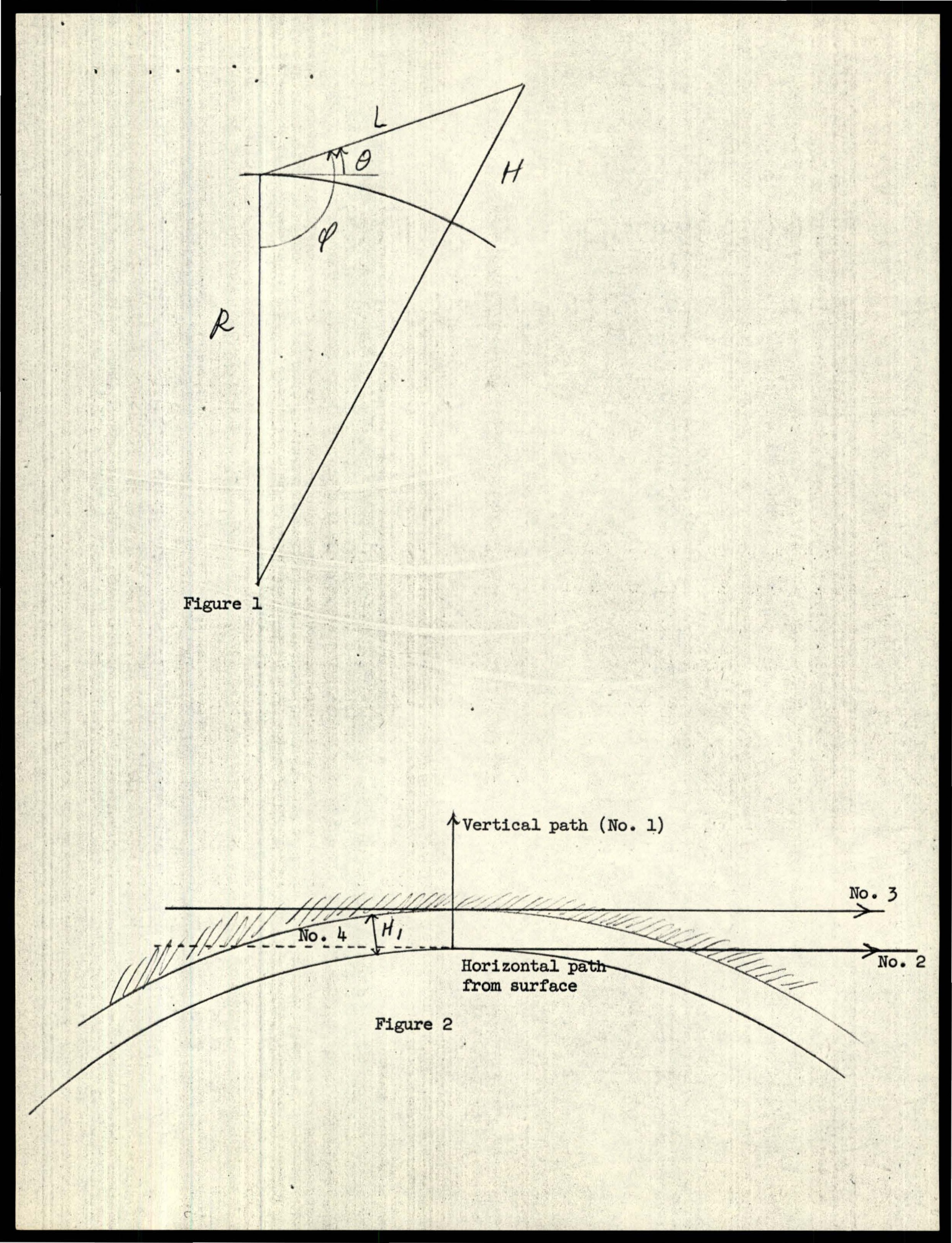
L θ H φ R Figure 1 Vertical path (No. 1) No. 4 H₁ Horizontal path from surface Figure 2 No. 3 No. 2
TO: -2- DATE: July 13, 1962
LOS ALAMOS SCIENTIFIC LABORATORY UNIVERSITY OF CALIFORNIA LOS ALAMOS, NEW MEXICO TO: -2- DATE: July 13, 1962 For the following I will assume that the concentration of absorbing molecules in the region of interest can be described adequately by an exponential decrease with altitud…
TO: Dr. Jocelyn Gill -3- DATE: July 13, 1962
LOS ALAMOS SCIENTIFIC LABORATORY UNIVERSITY OF CALIFORNIA LOS ALAMOS, NEW MEXICO TO: Dr. Jocelyn Gill -3- DATE: July 13, 1962 For a horizontal path (sin θ = 0) tangent to the base of a layer (path No. 3) we note that y << 1 in the contributing region, hence, can get an approximat…
TO: Dr. Jocelyn Gill -4- DATE: July 13, 1962
LOS ALAMOS SCIENTIFIC LABORATORY UNIVERSITY OF CALIFORNIA LOS ALAMOS, NEW MEXICO TO: Dr. Jocelyn Gill -4- DATE: July 13, 1962 Assuming that Y = 7 km in an absorbing layer, we note that a surface observer viewing a layer at an altitude near 100 km will have available the ratio N₂/…
TO: Dr. Jocelyn Gill -5- DATE: July 13, 1962
LOS ALAMOS SCIENTIFIC LABORATORY UNIVERSITY OF CALIFORNIA LOS ALAMOS, NEW MEXICO TO: Dr. Jocelyn Gill -5- DATE: July 13, 1962 From the report in Science, I infer that for the layer reported, 1 < σΝ₃ < 5 (16) or σΝ₃ = 3 ± 2 (17) giving σΝ₁ = 0.04 ± 0.027 (18) and σΝ₂ = 0.22 ± 0.15…
TO: Dr. Jocelyn Gill -6- DATE: July 13, 1962
LOS ALAMOS SCIENTIFIC LABORATORY UNIVERSITY OF CALIFORNIA LOS ALAMOS, NEW MEXICO TO: Dr. Jocelyn Gill -6- DATE: July 13, 1962 X₃ = 5.4 x 10⁷cm (20d) X₄ = 7.8 x 10⁶ cm (20e) Absorbers Present in the Upper Atmosphere Three constituents of the atmosphere near 100 km altitude absorb…
TO: Dr. Jocelyn Gill -7- DATE: July 13, 1962
LOS ALAMOS SCIENTIFIC LABORATORY UNIVERSITY OF CALIFORNIA LOS ALAMOS, NEW MEXICO TO: Dr. Jocelyn Gill -7- DATE: July 13, 1962 Nitrogen peroxide has been extensively studied and two papers were found which gave absorption coefficients in the visible region of the spectrum. Wiley a…
TO: Dr. Jocelyn Gill -8- DATE: July 13, 1962
LOS ALAMOS SCIENTIFIC LABORATORY UNIVERSITY OF CALIFORNIA LOS ALAMOS, NEW MEXICO TO: Dr. Jocelyn Gill -8- DATE: July 13, 1962 Readily detectable structure would produce variations of σN₁ and σN₂ of about half the attenuation figure given in equations (18) and (19) which is near t…
TO: Dr. Jocelyn Gill -9- DATE: July 13, 1962
LOS ALAMOS SCIENTIFIC LABORATORY UNIVERSITY OF CALIFORNIA LOS ALAMOS, NEW MEXICO TO: Dr. Jocelyn Gill -9- DATE: July 13, 1962 "pass through" the atmosphere, especially the absorbing layer (perhaps such sequences already exist). At the expected orbital height, I estimate a 7 km th…
TO: Dr. Jocelyn Gill 10 DATE: July 13, 1962
LOS ALAMOS SCIENTIFIC LABORATORY UNIVERSITY OF CALIFORNIA LOS ALAMOS, NEW MEXICO TO: Dr. Jocelyn Gill 10 DATE: July 13, 1962 field they saw, or to compare the intensity and color changes noted with that thru an absorbing cell containing NO₂. The required thickness is readily avai…
In reply refer to: SGC:ML:ml
In reply refer to: SGC:ML:ml 21 February 1962 MEMORANDUM Subject: Possible Scientific Visual Information Obtained by J. H. Glenn 1. Two (2) interesting observations were reported in the Press, as described by Colonel Glenn during the MA-6 flight. It is of vital interest to obtain…
- 2 -
- 2 - In a similar manner, the observations of the horizon and the extent of the atmosphere are of great interest in determining the distribution of various atmospheric characteristics. The precise lighting conditions regarding the position of the sun and the intensity of the ou…
HAND-CARRY NATIONAL AERONAUTICS AND SPACE ADMINISTRATION WASHINGTON, D.C. SPECIAL GPO 16-75511-1
NASA HEADQUARTERS ROUTING SLIP CODE | NAME (if necessary) | | ACTION | | | APPROVAL | | | CONCURRENCE 1. SGC | Fellows | | FILE | | | INFORMATION 2. SG | CL [ILLEGIBLE] EB 2 T Rec'd | | INVESTIGATE AND ADVISE | | | NOTE AND FORWARD 3. [ILLEGIBLE] | Cartright | | NOTE AND RET…
In reply refer to: SGC:ML:ml
In reply refer to: SGC:ML:ml 21 February 1962 MEMORANDUM Subject: Possible Scientific Visual Information Obtained by J. H. Glenn 1. Two (2) interesting observations were reported in the Press, as described by Colonel Glenn during the MA-6 flight. It is of vital interest to obtain…
- 2 -
- 2 - In a similar manner, the observations of the horizon and the extent of the atmosphere are of great interest in determining the distribution of various atmospheric characteristics. The precise lighting conditions regarding the position of the sun and the intensity of the out…
DRAFT OF NOTE ON THE SCIENTIFIC OBSERVATIONS Toward the end of the flight, between 16 hr and 47 min (UT) and 17 hr and 03 min (UT), 24 May 1962, Lt. Cdr. Carpenter made a series of observations on a luminous band visible around the horizon. The most decisive observation was made…
4. By noting the time when Phecda was halfway from the luminous band to the horizon. 5. By noting the fact that when the cross of the reticle the meridian bar is set diagonally, it just covers the distance from the band to the horizon. By method 3, we make use of the time of pa…
Sunrise was observed at about 1m later, while the observation was going on. It follows that the airglow is visible even when the twilight band is very strong. An attempt to observe it in the day is certainly indicated. In this connection, it should be noted that Capt. V. I. Griss…
It thus appears that there is a strong illusion which exaggerates angles near the horizon, and which was evidently also present in MA-6, since Lt. Col. Glenn also reports 7° to 8° as the height of the luminous band. The illusion is perhaps comparable to the well-known illusion wh…
package in a vacuum. The possibility that it might represent small particles from the fiberglass insulator was also considered; in view of the smallness of the fibers, it appears likely that they would have been blown away at once, like the Mylar confetti. The dynamic pressure of…
before sunrise, and rising to plus 10°C just after sunrise. During the second day, the temperatures were lower, reaching about -25°C during portions of the day. From about 3h 30m, CET, on the second period of sunlight, the temperatures were higher, and only one particle is mentio…
back. This supports the idea that the particles probably are pushed outward by the expanding steam from the capsule, before they begin to stream backward. It is probable that many of the particles lodge on the outside of the capsule, since Carpenter is quite sure, from the direct…
SCIENTIFIC DEBRIEFING June 1, 1963 (First Experiment - Flashing Light) John McKee: One of the first questions that I have regards some estimates you made of the beacon distance. Were those based entirely on the knowledge of how bright it was from previous aircraft training or…
Scientific Debriefing -2-
Scientific Debriefing -2- Bill Armstrong: Actually Gordo, it turned out, it gave you about a half of a degree per second in the opposite direction. This was very apparent on the postflight record. You can see your thruster action when you start to pitch up and then as you come r…
Scientific Debriefing -3-
Scientific Debriefing -3- had not completely set; I'm sure my retro pack area was in the sunlight. I'm sure that is what I saw glowing,--was the sun reflecting off of it. Although I had not seen it from previous viewing on the day side or the night side. McKee: When you didn't…
Scientific Debriefing -4-
Scientific Debriefing -4- Cooper: Well first I started trying to get my 180º yaw point. This is not the easiest thing in the world to get on the night side, and particularly when you have to go into your star charts 50 minutes ahead of where you had normally been used to using t…
Scientific Debriefing -5-
Scientific Debriefing -5- Cooper: The moon was probably ideal. It was down to about a third moon. It was a very distinctive moon when you could see it but it wasn't causing the great amount of light that a full moon would have caused. I could see the glow on the ground, on the c…
Scientific Debriefing -6-
Scientific Debriefing -6- Cooper: Well, not really. As I went into both night sides I could pretty well estimate 180º yaw. The first night side I was not completely around. I started yawing around and night was suddenly upon me and I wasn't quite in the full 180° position, so I…
Scientific Debriefing -7-
Scientific Debriefing -7- Cooper: Almost. Almost as it began to get dark. Of course it gets dark just like that. Zam it gets dark. I had just,--it was dark earth background and as I say my first feeling on seeing it was definitely coming from below very very slowly. As I watched…
Scientific Debriefing -8-
Scientific Debriefing -8- Cooper: It was just still slightly below the horizon. It had come up almost to the horizon. It had been a fair amount below it when I first saw it. In fact I was pitched down to about -34° and I saw it towards the bottom part of the window when I first…
Scientific Debriefing -9-
Scientific Debriefing -9- Bill Armstrong: You get a 30 degree angle view through the window. From the top of the window to the bottom, 30°. You can see over an elevation variation of 30 degrees. John: How far would he have to pitch down? Bill Armstrong: He would probably have…
Scientific Debriefing -10-
Scientific Debriefing -10- Cooper: Just once. Bill Armstrong: Did you do it twice or just once? Cooper: No, I kept it in sight for quite awhile and then yawed away from it and then came right back. Cooper: At 05:13:40 I made some comments on the Milky Way and various things a…
Scientific Debriefing -11-
Scientific Debriefing -11- Cooper: I think so. I think with that brightness, if you know approximately where to look for the thing and with it flashing, you certainly ought to be able to find it pretty readily. Day: Do you think similar experiments should be carried on or is th…
Scientific Debriefing -12-
Scientific Debriefing -12- Bill Armstrong: You feel brightness suitable for a rendezvous target would be something on the order of second or third magnitude. Cooper: Yes. Bill: That's one of the main things we wanted to find out. Does the brightness of the second night look ab…
Scientific Debriefing -13-
Scientific Debriefing -13- Cooper: Those deploy marks worked real well. They were excellent for getting in retroattitude also. They position your head to a real positive position. Bill: We have read the attitude records pretty carefully. You were between 20 and 22 degrees, so y…
Scientific Debriefing -14-
Scientific Debriefing -14- Question: What did it check out? Carmines: 62 (flashes per minute). Bill: Did you make attempts to see it on the day side? Cooper: I sure did. I never saw it then. Armstrong: It should have been closer on the day side than in the night portion. It…
Scientific Debriefing -15-
Scientific Debriefing -15- Bill: The spread of light isn't too great. Cooper: It is pretty hard to judge the light level. Mercer: Did you see the stars during this day? Cooper: Not this particular orbit. No I didn't. (Second Experiment - Balloon Drag) Day: Mr. Carmines will…
Scientific Debriefing -16-
Scientific Debriefing -16- Cooper: No. It was just a bit further to the left than I thought it would be. Bill: More toward the center of the window? Cooper: No. More slightly to the left of the window. I could have been yawed off a little. I thought the pattern of the little t…
Scientific Debriefing -17-
Scientific Debriefing -17- Cooper: Maybe as long as a minute. I doubt if it was that long, probably 30 or 40 seconds. I lost it because it got too weak. It was a long ways from being straight out on the horizon but as it got on up towards that direction it faded out Bill: In ch…
Scientific Debriefing -18-
Scientific Debriefing -18- Cooper: Yes, it got dimmer. Mercer: Could you see lights of cities through layers of clouds? Cooper: I saw a lot of cities underneath the clouds. One of my best retrofire yaw alignments was over Shanghai. Mercer: Were light patterns more distinctive…
Scientific Debriefing -19-
Scientific Debriefing -19- Cooper: Definitely: The ideal would be a series of lights. A better combination would be a series of flashing lights arranged in some pattern. Maybe like a running rabbit strobe pattern. I am sure it wouldn't have to be synchronized. Bill: You mention…
Scientific Debriefing -20-
Scientific Debriefing -20- Cooper: You're going to have to be right on in attitudes. You're going to have to know exactly what time it's going to occur. I'd guess you have about 20 to 30 seconds to do your actual sighting and you have to have a good angle off to do it. Bill: Ho…
Scientific Debriefing -21-
Scientific Debriefing -21- (McKee continued) you say why you saw such SMALL items? Cooper: I was coming from Houston the other day in a 102 and I noted I couldn't see nearly as clear around 40,000 feet, particularly in one area that I was in. There was a lot of haze and it was…
Scientific Debriefing -22-
Scientific Debriefing -22- (MIT Horizon) Dr. Peterson: The purpose of these pictures is that we are trying to find definite information about the earth for Apollo guidance. This is one of a group of four pictures taken in four different yaw directions, one into the sun. Is this…
Scientific Debriefing -23-
Scientific Debriefing -23- Dr. Peterson: There is a smudge in the middle of the window. It could have been accidently concealed. Since these negatives are only suitable for microdensitometry there doesn't need to be any discussion of the details of their significance. (Infrared…
Scientific Debriefing -24-
Scientific Debriefing -24- Soules: You made the remark that you were coming over Africa. Do you have any more information? There was none in the transcript. Cooper: What base was this on? Bill: Wasn't one of them over the coastline? Cooper: Yes, I did one right on the coast o…
Scientific Debriefing -25-
Scientific Debriefing -25- (Cooper continued) a brown look. Everything predominantly had a bluish cast. All the water, all the sea water, looked very very bright blue. Even the Salton Sea looked very blue. And areas we know were heavy forest areas looked kind of blue-green. The…
Scientific Debriefing -26-
Scientific Debriefing -26- Cooper: I could not see distinct lightning patterns. It just all lit up. The whole cumulus mass of clouds would light up. Soules: Did you notice thunderstorms between Hawaii and California. Cooper: Yes, several off the west coast of the United States…
Scientific Debriefing -27-
Scientific Debriefing -27- Cooper: No. I noticed several large cyclonics. I did not notice any very distinct sharp bands. However I did notice tropical thunderstorms. Near the Solomon Island Areas there were a lot of low streets and ridges of smaller cumulus clouds. There were l…
Scientific Debriefing -28- Soules: Was the horizon always a sharp line? Cooper: Yes, day and night the horizon was sharp. In the day you have this bright blue band around it. Soules: Some photos show the horizon seemed fuzzy. Cooper: In the Himalayas on a couple of occasions wher…
Scientific Debriefing -29- Cooper: The stars in the Big Dipper could just be seen. I noted the Big Dipper with the bottom star sinking down into it. Soules: The top of the layer would be how many degrees above the horizon? Cooper: I figured it was about six or seven degrees. (Lon…
Scientific Debriefing -30- Soules: You saw something over South America? Cooper: Yes, there is this other higher level I saw over South America. Stanley Soules: Did you see different cloud layers at night? Cooper: Only if there was moonlight and if there were towns or cities belo…
Scientific Debriefing -31- Dr. Voes: The day sides get a lot lighter, at night they are about the same darkness as the inside of the spacecraft. Cooper: The night sky and the day sky is about the same as the difference between a jet black and a dark gray. (It is about the same di…
Scientific Debriefing -32- O'Keefe: Somewhat of a pattern? Cooper: That's right. A pattern over the outside of the window as well as the scum on the inside. O'Keefe: If this had been scattered light you would have had this pattern? Cooper: That's right. (Dim Light photographs.) D…
Scientific Debriefing -33- Cooper: It wasn't so distinctive as to move back on to it. It was very faint and definitely lighter than the sky. It was picking up some light of some type. It was light in contrast to the sky. Dick Day: Could you see this better out of the corner of yo…
Scientific Debriefing -34- and spread. It doesn't take long. As it goes on down you still have this orange pight on the horizon and this area is all considerably lighter although black is coming on down. You do get glow up off it. You could actually swing away and tell right wher…
Scientific Debriefing -35- Roach: Is this phenomenon very close to the sun? Cooper: I had the feeling that this was just a glow off the sun. It was not as bright as the Milky Way. Mercer: Was it tipped to the right or left of sunrise? Cooper: I was sitting tipped myself and don't…
Scientific Debriefing -36- Roach: From that standpoint, is it better to retro in the daylight? Cooper: You could probably do it at night, but it is preferable to do it in the day. Note: The next few comments are not interpretable, but it appears someone raised a question about th…
Scientific Debriefing -37- Cooper: I would guess it was on the order of 20 to 30 seconds after sunset, that is just a guess. And this is all the counting I was doing to give you the timing and there was interference from the ground stations. Huch: Did you observe capsule stabilit…
Scientific Debriefing -38- Shepard: Did you get any readout on attitudes? Mercer: We got good attitudes. Huch: On the pictures, can you relate the airglow band to what you drew on the board? Did you take any exposures into the sunlit sky? Cooper: No, I didn't. I was going to try…
Scientific Debriefing -39- Warren: Did you take it off prior to retro? Cooper: Yes. I took it off just prior to retro. I stowed it in the glove compartment. Warren: Did you take a reading of it at any time? Cooper: No, I didn't. Warren: Did you place it vertically? Where did you…
Scientific Debriefing -40- conservation. It does take a certain amount of power. McKann: That decision was made not to turn that on continuous because it had never been checked out for continuous operation because of some difficulties that might arise because of this. Shepard: Th…
Scientific Debriefing -41- (General Observations) Dr. O'Keefe: I understand the hissing noise was completely negative. Can you be sure it was not then? Cooper: I didn't ever hear it at all. I had good fitting ear caps. Dr. O'Keefe: Were you listening for it at the time? Cooper: Y…
Scientific Debriefing -42- Paul Lowman: When you were over the deep ocean could you see any evidence of currents, at the coast of Africa or the coast of South America. Did you see different colors? Cooper: There was some slight difference in color. I couldn't determine a pattern…
Scientific Debriefing -43- the city of El Pase. I could see some little isolated civilized areas. I never did see the main part of city. Paul Lowman: Did you see any distinct shadows from the terrain? Mountains? Cooper: Yes. You could see shadows of the mountains quite clearly. E…
Scientific Debriefing -44- the East coast. But there was a quite a bit of clouds up north, broken clouds. Paul Lowman: Were there any unusual terrain features? Cooper: ...... Dr. O'Keefe: Did you see anything that looked like a crater? Cooper: No. I sure didn't. I was looking for…
Scientific Debriefing -45- not real. fast. I could see them move right on out. In a matter of 4 or 5 seconds they would be as far away as the other end of the room. (50 feet). Some you could see for maybe as long as 30 or 40 seconds. Question: Do you mean back from you or back al…
Scientific Debriefing -46- Question: Could you determine wind direction and velocity by smoke? Cooper: I could tell direction - over the Tibet area the wind was from the south. Question: Did you see industrial smoke? Cooper: I remember one fairly large area there was considerable…
Scientific Debriefing -47- O'Keefe: Yes, they do overlap. They are pretty badly tilted, but they do overlap. Hanel: Did you have difficulty in seeing Cirrus clouds? Could you estimate how much of the surface was covered with Cirrus? Cooper: Surprising little of surface was covere…
Scientific Debriefing -48- Dr. Voas: You seemed to have the general impression that you were stationary and everything else is moving. Cooper: That's right. You sort of become the center of everything, and you think how you can move the earth around, when you want it, rather than…
Scientific Debriefing -49- Dr. Voets: At retro fire, did you note feelings of lateral motion? Cooper: On the third one, it gave me pretty good little boot in yaw. Dr. Voas: This is distinguished from what you could see looking out? As I understand it, you felt the retro rockets b…
Scientific Debriefing -50- Boynton: Did you find that later in the flight audio inputs became more startling or more distinct? Did they seem to be more profound? Cooper: Later in flight, I began to notice the relay panel wiping back and forth whereas I hadn't noticed it before. T…
SCIENTIFIC DEBRIEFING OF LT. CMDR. WALTER SCHIRRA HELD AT NASA HEADQUARTERS, TUESDAY MARCH 12, 1963
FOR OFFICIAL USE ONLY 15 November 1963 In Reply Refer to: SM(JRG:nem) MEMORANDUM FOR: All Participants FROM: J. R. Gill SUBJECT: Scientific Debriefing of Lt. Cmdr. Walter Schirra, held at NASA Headquarters, March 12, 1963 This document is a literal transcription of the subject de…
p 1 & 2 Dr. Eugene M. Shoemaker, Chairman, Manned Space Science Working Group served as Chairman, substituting for Dr. John Clark, Chief Scientist. The following people were present: Mr. Carl Abraham, NASA Headquarters Mr. Richard Daniels, NASA Headquarters Dr. Winifred Cameron,…
3 great length and I don't know whether we could be any more expansive on that subject than we have already. The only thing that I can think of that we didn't talk about is an effective color of the planet Mercury. It was as white to me as any other star. It was not blue, red or…
4 Schirra - Again, Larry, do you have that? (Referring to drawing prepared by W. Cameron and L. Dunkelman) Mr. Dunkelman - We have. Schirra - We sat down for about an hour and traced this very carefully. Mr. Dunkelman - It happens that the movement of Mercury behind our atmospher…
5 not that much of an artist or poet, but I was trapped with this set of blues and I did expand on it at greath length, I thought. These electric blues - O'Keefe - (Interrupting) Subtraction is what it sounds like. Schirra - So it connotes ozone in that sense - electric blue - is…
6 is about the best way I can describe it. I could see more stars, as Scott Carpenter described it, when back on the surface of the earth and many, many more stars in an airplane cockpit than in orbital flight. Roman - You could see more in an airplane? Schirra - Yes. So in the d…
7 off in the vacuum? Schirra - This might be a way of doing it. Having it sublime away or something of this order. O'Keefe - That could be done. If that were done ... Schirra - I definitely feel that this should not be a neglected problem; if we, for example, do remove the window…
8 Nordberg - Could you, were you able to observe, during the orbital flight any decrease in the film on the window. It may have evaporated away, or did it just stay? Schirra - I was hoping to see that and I did not observe a decrease. This surprised me too. I would anticipate tha…
9 why I asked the question because we observed this on Tiros too. One of the two cameras was just completely clouded for a few hundred orbits and then gradually after a few hundred orbits it improved a little bit. Schirra - I need a little more flight time! I'm all for it. Nordbe…
10 of gas like that the ambient pressure - the general ambient pressure - is quite different from the pressure right around your vehicle. I still wonder whether you can get the pressure up around the vehicle for the level where condensation takes place. I have been trying to pers…
11 but I think this is basically why we refer to the white particles as frost because it does remind us of this. This is what probably tempts me to say that it has to be water. Cameron - Do you think the chartreuse ones were maybe the ones that Glenn thought actually glowed, didn…
12 explanation. If it is really true that this chartreuse color only turns up only at sunrise, we may be with the explanation that Herzfeld1/put forward for it. Schirra - This is the nitrogen effect? O'Keefe - Yes. Schirra - I would like to stamp that one out. We can't afford to…
13 you just can't purge particles in the interior in that these are angles and trap volumes, but I would suspect that we had a very low order of nitrogen gas within the vehicle that could come out. Now it can come out if the vehicle's leak rate - in the vehicle is excessive - and…
14 Shoemaker - Any other items on airglow we should take up? Schirra - We will bring up this other thing I saw - I guess? Shoemaker - The cloud (bright area) you saw over Madagascar? Schirra - Yes. Dubin - I was wondering on these various effects on the horizon. You make some sta…
15 meant that it was off to the left of my yaw angle - I was in flight path in yaw at this instant of time - which means you could determine where the vehicle was oriented and then also get the sun-line in relation to the window. Cameron - Incidentally, the sun must have been ver…
16 relatively dark blue band right at the surface of the earth. Of course, the orange and light yellow was changing at this point and I then came into seeing this dark blue band. In other words, I had lost the orange cloud effect just above the surface of the clouds. This was the…
17 I was referring to here as the transition from the last blue band I could see to the total darkness of space. I guess this is the only way I can describe that. This was a surprise to me to see this, really. O'Keefe - Well, it is astonishing, isn't it? Schirra - Yes, it is. I e…
18 Schirra - Yes. Now as we progressed in time to the second drawing, the sun has now really set and the reds and yellows (in the drawing) are fine ... now just getting the afterlight ...that's the ragged effect I saw. ... Schirra - This isn't as thick as that grey to black band…
19 clear to you that the internal lighting was off inside the vehicle. I don't know why I didn't bring that point out. This reminds me that it was dark and it was 0605 52. I had to see what time it was. We had this counter clock as you know, and to see the numerals I had to bring…
20 Schirra - Very good, a better way of saying it. O'Keefe - "Airglow" is a very complicated term. We don't know what it is all about. That's what we are after. ... Schirra - In fact, on occasion I have used airglow through here just out of ignorance. I think what we all are tryi…
21 like a star. O'Keefe - I think when Nicks asked if the sun changed in size, he really - the sun doesn't change in size as it sets. He meant change in brightness. Schirra - Apparent size - not the size, but the illusion at least. I've got to break off a second here. I don't rec…
22 Schirra - Paul Backer could trace them down at least. He was the film-handler. He could chase them down. O'Keefe - Minnaert has suggested that after moonset, that there might be a lunar zodiacal light. (Minnaert, Light and Color in the Open Air, p. 295.) Schirra - Oh. O'Keefe…
23 blue scout had been launched from Vandenberg (AFB). It had the most fantastic lighting I have ever seen anywhere. It had the exhaust trail and above the horizon it had this fantastic glow - ionization glow (like a vapor cloud) I would describe it as - which would best pin down…
24 O'Keefe - It is not a difficult thing to see the zodiacal light under reasonably favorable conditions. Schirra - No, I have seen it frequently, but not as brilliantly. Gill - Have you seen it in Houston by any chance? Schirra - I have seen it just flying at night. I haven't se…
25 we are going to see a batch of clouds if it's lighted, (the earth) That's really what I saw a lot of. I was just amazed. Obviously, when I flew over Africa, it was loud and clear and you would see this if you were looking at Africa from some vantage point many, many miles away…
26 Schirra - Correct, that's when I came into it. O'Keefe - What was the height of the layers at this time - 66 kilometers, is that right? Schirra - Right, that's what I was saying. I hope we can hold Mercury meaning that I'd like to see it go through this and I did not know that…
27 Mercury were traversing was in a plane something like this. This is your point I think, Larry, Isn't it? Dunkelman - That's one ... Schirra - So they come down this way which mathematically isn't hard to solve, but you should consider this. Dubin - This plane may vary a certai…
28 Schirra - If there is another one of those coffees, I'll trade this one in. I don't mind it cool. Break (General conversation)
29 Schirra - And the rare occasions that I've had the timing for this. O'Keefe - There is a nice Delta Flight from Washington down to Houston. The thing goes exactly toward the sun - you can't miss it. Cameron - You'll have to go to the cockpit. Schirra - Hmm - You have to make t…
30 O'Keefe - Yes, he gave me a note. I was supposed to pass that note down to the Manned Spacecraft Center; I don't think I did. I think it's my fault. (Ed. copies were forwarded to MSC.) Roman - What is this you are referring to? O'Keefe - There is a very strong magnetic anomaly…
31 Cameron - Was this a patch, or do you think there was a layer there? Schirra - It was a layer across my whole visible horizon. It wasn't just a blob in other words. Cameron - And is that the only time you saw it? Schirra - That is the only time that I recall ever having seen i…
32 Dunkelman - We are here to hear yours and I think we should figure out some more of this. I don't want to inject my thought into this, but I was trying to quote you in saying that it is brownish smog layers and wasn't sure how to define it. Schirra - Yes. This is dirty brown,…
33 would prove that the stars well could be seen going through the same traverse. This thing I saw - let's just call it the smog belt - on this southern pass, to go back and recap the sensation that brought this to mind which is not brought out here other than the fact that I can…
34 Dubin - Was there any color whatever in it? Schirra - In the airglow that I saw? No, other than during sunset times where you would have sunlight itself. Dubin - No color whatever? Schirra - I think of white as being all colors and you can see I've been trapped with painting a…
35 everybody thinks that all you see is Perth! (laughter) Well, we see a lot of other places as well." To go back, I was trying to re-establish this phenomenon in my mind so I had passed over Africa and I was darkened within the vehicle. I was drifting. As I was drifting - we lik…
36 my dark adaptation and light up my star chart and then identify these things. This is the problem we have. O'Keefe - One of the classic problems in astronomy - one of the solutions for it is to illuminate with a red light, because you don't destroy the dark adaptation so quick…
37 Schirra - I feel that I was looking up at it now in relation to my local horizon. Roman - You were actually looking up at it? Have you any idea how high it was above the apparent horizon at that time? Schirra - That is where I am in trouble, Nancy, because there is no direct r…
38 mackerel effect that you see in clouds. This is very much a - well, I would say if you really wanted to do it - well, do it in water colors rather than chalk. Nordberg - Did it cover your entire field of view? Schirra - It covered my whole field of view, yes. That's where I "s…
39 could look down at the different angles. Schirra - We had a mirror on there. This permitted me basically to look toward the heat shield. Something like a rear view mirror, except it was a front view mirror in Mercury. But in any CASE, you almost need - we need something like a…
40 Cameron - I was wondering if you recognized this pattern here that you saw below it? Schirra - What really flipped me--this is where I got in trouble-- I said something about the Pleiades and I know I could not see those. Cameron - You see according to this the Moon was up at…
41 (Conversation inaudible) Schirra - I used to carry my little star chart slide rule thing around with me. Roman - Alternatively, there are some (star) clusters - well, if it's the Pleiades, it would be well enough defined and you wouldn't confuse it - there are some clusters in…
42 Schirra - I don't think they are in this area. We have to expand this star chart. Now if I were yawed around 90 degrees, this star chart is absolutely worthless because this only goes a plus or minus 60 degrees. O'Keefe - I know, I know ... Schirra - Maybe I could have ... O'K…
43 surface of the earth; physically, I just couldn't see it. Roman - That's what I meant when I said at best you-d see those just before sunrise--if at all at this time of year. Schirra - Right. It was just impossible for me to see it at this point way back here, so it was occlud…
44 Shoemaker - Why don't we say we'll plan on this and then we can make the arrangements -- Schirra - I am afraid that I can't do it rapidly, but I'd say the first part of April would be okay. Shoemaker - Jocelyn, would you like to take this on to set it up and follow it through?…
45 in the airglow and I did not see it? Dunkelman - We are trying not to - (influence your reply). Schirra - Playing one (response) against the other is indeed a good way of doing it. Dunkelman - Another think is that this was indeed brighter. Schirra - But, well below. ... Dunke…
46 anything else. So I was strictly looking, if you could almost say, I could even be looking straight up, which I know I wasn't. The stars were equally bright and equally in number almost on either side of this band. Dubin - It was about through the middle of the window? Schirra…
47 back to the planetarium (to reconstruct his flight path.)... Schirra - I sure wish I had thought of this a long time ago when I was fresher on this. Gill - It would fix things in your mind too - you'd be able to see them again right away to pin them down. Dubin - How long did…
48 than beat this any further, it's circumbent on us to go to the planetarium and really nail this down. All I have to do is just take this window box we have and just move it around and - ah ha - there it is. Dunkelman - Something we would like to know is the dimming effect. Sch…
49 capsule? Schirra - We have answered that with the fingertips. Shoemaker - Did the light of the "time-correlation clock" shine in your eyes throughout flight? Schirra - The answer is no. They put in a switch to turn that off and I turned it once and it was never turned on again…
50 became a liability, because we had then to bring on light again (I brought on the finger tip lights to do this). Gordon knows how strongly I feel about the star chart device. This is a valuable tool. But it required two tools and a slider. Actually, two tools, with sliders on…
51 and you could see what you needed on the chart. Schirra - Now this could be practiced in a planetarium. O'Keefe - There are plenty of fluorescent inks. Schirra - This star chart thing was a real problem even to get it to the degree of refinement that I had. Gill - It has a whi…
52 Dunkelman - The Navy has done this very carefully. Schirra - It can be destroyed very rapidly. It turns out quite frequently when you are in a cockpit and you're time-critical, more so than when you are on a carrier deck for a night launch than when you are on the pad. Things…
53 Cameron - I saw the zodiacal light once doing that in Chicago. I came out of a lighted building. It was the first time I had seen it. It was in a part of the sky where I didn't expect to see it. Schirra - I think that our test, frankly, that have been conducted to determine da…
54 it on. I think they are trying to trace that through. It wasn't Aldebaran, that's for sure. Dubin - You say that you never saw your fluorescent numbers on your watch? Schirra - No, I did not. This bothered me. Dubin - Did you look at it? Schirra - Yes. Dunkelman - Is this some…
55 Nordberg - I am curious if you had a chance to observe variations of brightness around the horizon; around as far as possible (during) both in day and night. Schirra - Again, the field of view isn't that big. I know just what you are asking for. I didn't take the liberty of ma…
56 pitch, like this, roll, pitch. In other words, you step your way around. It is not a smooth maneuver as you would anticipate in an airplane where you just roll and come around and cut a swathe without changing attitude. Nordberg - In daytime, it should be really a striking thi…
57 Schirra - These things you can't define by numbers. In spite of what my philosophy was for this flight you can't resist making scientific observations. That's taped? I think it's legal. Gill - That's what I thought--You wouldn't be human if you didn't. Nordberg - I would like…
58 nimbus that stands out like a ruler in relation to the vertical plane. I think it might be here (in the record). Nordberg - I have seen some of the films. I don't know if they were your flight or previous ones. I am just curious whether the eye sees something better than what…
vchining 59 This was sort of interesting because I described the thunderstorm flashes of discharges as blobs of lightning.
60 BEGINNING OF THIRD TAPE Schirra - I could not pick up cloud structure because I was looking down and at this point, you don't have time, and I don't think your cues are good enough to separate elevations. Nordberg - You don't recall seeing any clouds when there was no lightnin…
61 Schirra - No, that was only during this area. This could best be described as the eastern half of Australia. Dubin - Did you notice any lightning while looking down - you couldn't see the flashes away from the capsule? Schirra - No, oh no, no, I didn't get any light fed into t…
62 yet to do this - in aircraft - in all the times I've been out there - see all of the Pacific. I have never had that opportunity, and I don't know that anybody ever will. Tennyson - I think what he was getting at is when in the TIROS satellite - the cottonpicker goes over and t…
63 Nordberg - There are some thoughts that by polarization and so, one can distinguish it over a uniform surface; of course, the eye doesn't have this, but I'm just looking for a clue that the eye might have which we hadn't thought of in an instrument such as depth, because it's…
64 do with spare part items or items like that. Nordberg - It's again the depth. Schirra - Well, we are working a movie camera where TIROS is taking stills, is what you are saying. Tennyson - Exactly, and you imply a height which the eye in itself in a still picture mode can't se…
65 the best print available, and I definitely have this group on that list. For one, I am disappointed that this occasion where I pulled this Weather Bureau filter out of the back to take these two pictures of the moon, I have heard and I have yet to have seen the graphic results…
66 don't have the 70 mm. yet, but as soon as they become available, they'd send them to us, but actually we haven't really received anything from them since and the only time that I have seen some of these photographs that you are talking about ... Schirra - Well, Kleinknecht doe…
67 opportunity to see a highway, for example, and trace it, because I wasn't over those populated areas such as the Southern United States long enough or had the clear weather to just sit there and observe them. In contrast, I think what you would do if you saw something and want…
68 on the axis which is easily the equivalent of 800 million candle power...single flare on the ground ... Schirra - uh - huh -- O'Keefe - Well, I think 2 or 3 million is the biggest thing they ever tried to use. So the directed beam has quite a big advantage over the undirecte…
69 the man to brief me on it, and I since have read up a little bit further on this exposure meter and there is a little soft, white cap that goes over the eye of the exposure meter which takes diffused light. It doesn't change the light meter reading, but it basically then takes…
70 lot of information about these flights. Schirra - That was my intent in taking the exposure meter and the Hasselblad because you took light values rather than F-stops and shutter speeds and this means nothing... those numbers. The light values connote exactly what you want to…
71 ground as to structure. Could you infer anything about it? Schirra - Amazingly enough I felt I saw every bit of what I see here. The terrain changes, the rivers - one of the best shots - this is of course, South America, that's the one I'd like to use in fact - when I came ac…
72 O'Keefe - I think this is swamp and it's very shallow. Gill - You never would see it then. Shoemaker - In photographs I've seen from previous flights, both Glenn's and Carpenter's flights, I think we got some pictures on Africa, and I was quite interested in these because th…
73 Schirra - As an example, I was hoping that I could look up at Japan after retrofire, and I couldn't see it at all. It was clouded in too. Tennyson - Japan, this time of year, looks like it would be cloudy. Nordberg - Particularly at this time of year - this was October, so t…
74 estimate it to be about 80 to 90%. When I went over - the United States was clear east of the Sierra's, but it "sacked in" (clouded over) again by the time I got to the Gulf of Mexico, so I just had a SMALL band when you look at this part of the United States. This is not very…
75 O'Keefe - There's a 10,000 foot peak (Haleaki) or Maui. Dubin - How were you overall set for time? You were up to the sixth orbit and you had some trouble with your suit, so we found out. Did you have time to basically do more scientific work than you had the privilege of doi…
76 was that really Mercury? Well, I knew it was Mercury just by having had the opportunity to have Mercury projected on approximate launch day, so I knew it had to trail the sun, and everytime we ran the planetarium, we had Mercury projected tracking the sun, on the same path, of…
77 to me. I said, "Well I, that means I must go left," and as I came left, I started picking up other stars which became known to me through the starfield that I had rehearsed. Then the moon and Venus showed up and that was here. O'Keefe - It must be very difficult to pick up co…
78 chart, bending it around. (Laughter) Gill - It's very hard to get oriented. Dubin - Did you or Glenn or Carpenter see any meteors? Schirra - No, and we were naturally anxious to see them. I understand some little Japanese boy picked up one recently (Comet Ikeya). Isn't that…
79 Nordberg - How about color? Was it very dark blue? Schirra - Oh it went from blue to black. Not an appealing blue by any means. Dunkelman - Well, really to be fair to an astronaut, one ought to take a replica of the window and go in the dark room and illuminate it side-wise…
80 gleaming thing. Schirra - The only opportunities I had for looking vertically were during boost and re-entry and a lucky chance while drifting. O'Keefe - If you are going to observe during the daytime, the whole window has to be turned so that the window doesn't look at the…
81 Schirra - That's our liability with the window being on an external surface. You are that close to the top of the well, so you get incident light all over the place. O'Keefe - We don't want to create artificial problems here. That smoke scum on the window would not really dis…
82 just look at the night sky and then again, having a low level source coming up and even if the window is absolutely clean what happens with these eight reflections. Schirra - Sure. Dunkelman - You see, the problem of not letting anything look at the sun or letting that look…
83 I admit this is my old pitch, but still he will have a lot of time to do things. So he has a number of experiments on his flight and he definitely will perform these. Now, in my CASE once I solved the suit circuit problem, I really didn't have many problems. Frankly, none to s…
84 We don't like to let things go on without knowing at what they are; and you explore them pretty thoroughly, maybe with limited know- ledge, but at least you try to get it down. I have been fighting like mad to get this continuous tape recording. This was invaluable to get answ…
85 the Indian Ocean Ship. Dunkelman - Yes, but the point is this is the return, what I'm trying to get at -- the moment you saw that which no one saw at the time on the ground is the beginning of a new period which we have to take advantage of on the next flight. Schirra - Oh,…
86 Tennyson - It's good to have somebody else who isn't constrained to party lines. Gill - It's a privilege to meet with you, really. Tennyson - Something that shocks me is that the discussion from Scott Carpenter and your discussion is the picking out of clues from about, heav…
President he can observe and make plans judgments that no instrument Apollo Glenn, or animal can accomplish. tried to As an example, Douglas said that Glenn, on his own initiative, had turned his spacecraft around 180 degrees on his second orbit to see whether the mysterious "f…
Outer Space Sciences Some Considerations and recommendations of Manned Space Exploration Following the Interview (Feb. 27) with Lt. Col. John H Glenn Jr. Recommendations 1. Publication Sci Journal - Astronaut Observation Additional support to Astronauts - - instruments - Follow…
Memo Glenn Some consideration of Manned Scientific Space Exploration Following the Interview with John H Glenn Jr → Glenn scientific paper ← → [ILLEGIBLE] - discovery - horizon bit - not window Luminous particles - Velocity & → Rean "Artificial comets" Recommendation Suppor…
- Conditions described = per head - to the [ILLEGIBLE] = observed for 3 1/2 to 4 min - from first light of sun. = observed on all three (3) orbits = very luminous - yellow green color (bright [ILLEGIBLE] = white cloud) = 2 to 3 meters separation = velocity thru the field - 3 to 5…
- IR U.V. camera - light meters
- Glenn - 10 - 15 min normal dark adaptation 727% window cut down - daytime stars > min adaptation = Sun not too blinding - could look at it. Very clear brilliants white light - a like arc lights Sunset - broad band on atmosphere - with 60° arc - yellow - orange - blue - bla…
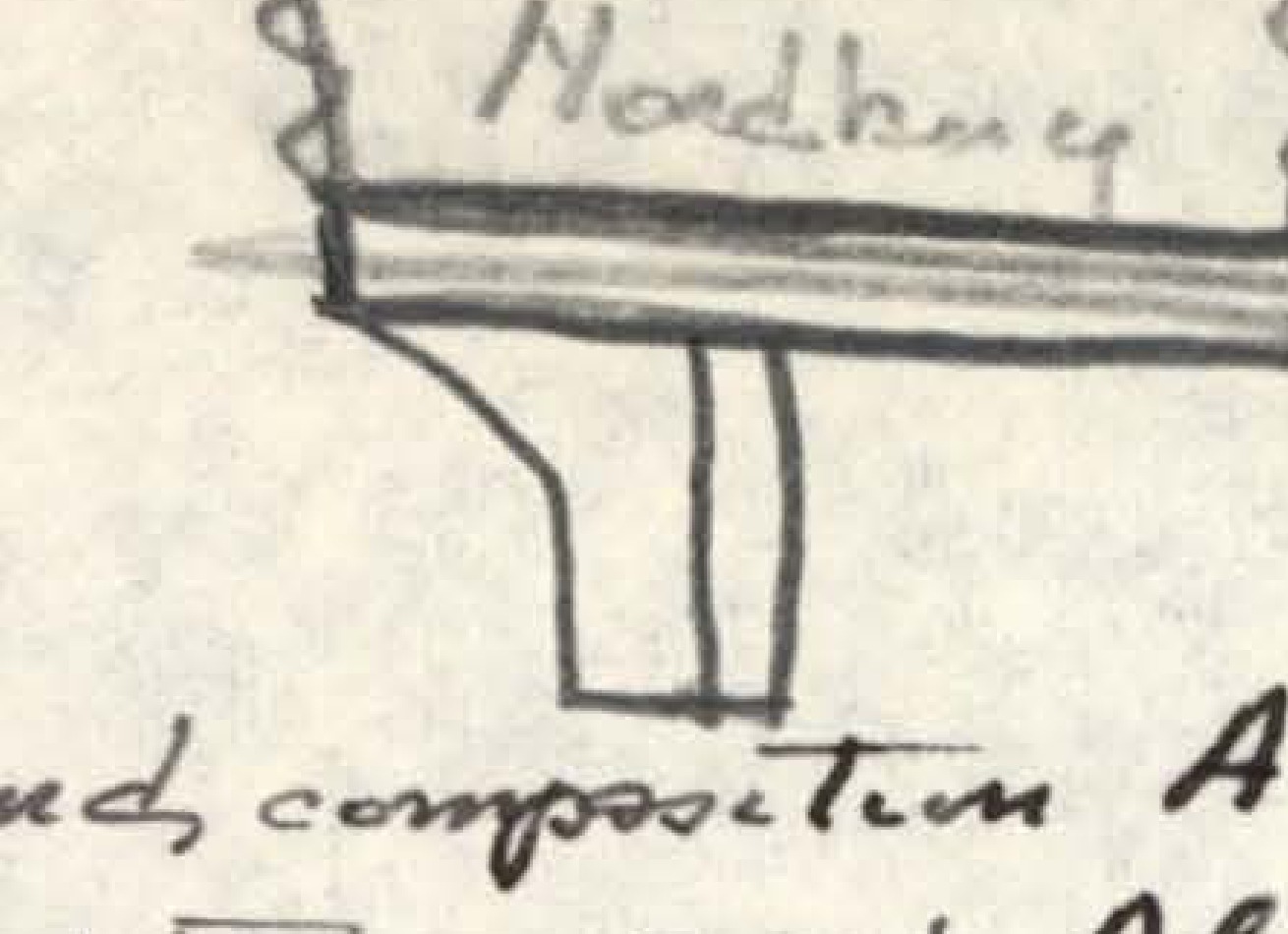
Nordberg #4 - G2O2 and composition A. and, 7 NIT - and A2 No o 40% Al powd 30% Potassium perchlorate 30% Barium nitrate 50km to 150km 6 or 7 rockets ~15L Dyan Dyer Dublin 13- load - directly NASA → Editorial - board & - next or Ju…
- all moving in same direction ~ some seemed to flow around = brilliant as sun so-as fireflies in blue-brown night - very steady light = yellow green ~ no end to them -- in all directions - white - past window - piece of cotton ~ all moved at same speed - oblate spheroid ~ no cha…
"Meteors" (A Symposium on Meteor Physics): Special Supplement (Vol. 2) to J. Atmosph. Terr. Phys. (1955)
"Meteors" (A Symposium on Meteor Physics): Special Supplement (Vol. 2) to J. Atmosph. Terr. Phys. (1955) Meteor Ionization in the E-region MAURICE DUBIN Air Force Cambridge Research Center, U.S.A. ABSTRACT The theories of meteoric interaction with the atmosphere have been revi…
112 MAURICE DUBIN
112 MAURICE DUBIN Since the velocity distribution of meteors is over the range from 10 to 70 km/sec, for the purpose of computation an average velocity of 40 km/sec was used. Pmax and nmax were determined accordingly. From equation (1) and WATSON'S (1941) estimate for the number…
Meteor ionization in the E-region
Table I. Calculation of the number of electrons produced per cm of path per meteor and per twenty-four hours as a function of visual magnitude. (number in upper right is power of 10) Height = 85 km | Height = 100 km | Height = 115 km Visual magnitude | Observed No. of meteors |…
114 MAURICE DUBIN
114 MAURICE DUBIN consideration of long-duration meteor echoes it has been suggested that the electron density in the trail is greater than the critical density for the radio wavelengths employed in probing meteors, and has led to a REVISION of the Herlofson ratios for the produc…
Meteor ionization in the E-region 115
Meteor ionization in the E-region 115 the micrometeorite and the subsequent ionization by the freed particle. Experi- mental information on collisions of neutral particles and the resulting excitation and ionization is very limited. Much of the available information is contained…
116 MAURICE DUBIN
116 MAURICE DUBIN found by HEALEA and HOUTERMANS (1940) was in the range from 0.2 to 0.05 for ions of He, Ne, and A at about 400 eV. The impact of ions on a solid surface results also in a process known as sputtering, wherein atoms or clusters of atoms are ejected from the surfac…
Meteor ionization in the E-region 117
Meteor ionization in the E-region 117 now the electron density. For SMALL particles, where the number of electrons formed per centimetre of path is SMALL, the diffusion term is predominant, and the train quickly decreases to the equilibrium electron density, which is thus given b…
118 MAURICE DUBIN
118 MAURICE DUBIN MASSEY, H. S. W., and BURHOP, E. H. S. (1952) Electronic and Ionic Impact Phenomena (Oxford, (Clarendon Press) MITRA, S. K. (1952) The Upper Atmosphere (The Asiatic Soc., Calcutta) PAETOW, H. and WALCHER, W. (1938) Zeits. f. Phys. 110, 69 RESLER, E. L., SHOO-CHI…